



Improving Brand Reputation with Glassdoor Reviews
Table of Contents
Protect Your Reputation
Restore customer trust with proactive positive reviews.
Boost Online ReputationFor years, online reputation management focused almost entirely on customer reviews. Companies poured resources into Google, Yelp, and Trustpilot to ensure prospective buyers saw high star ratings and glowing testimonials. Today, that strategy tells only half the story.
Job seekers research prospective employers with the same scrutiny customers use when buying a product. Before a candidate submits an application or accepts a job offer, they look at what current and former employees say behind the scenes.
Glassdoor has become the primary window into corporate culture. A low rating or a wall of unaddressed negative feedback can quietly drain your talent pipeline, increase cost-per-hire, and leak into your broader consumer brand. Conversely, a transparent, well-managed presence can become one of your strongest assets for recruitment and public trust.
This guide outlines how Glassdoor impacts your business, how to handle bad feedback, and how to build a resilient employer reputation ethically without risky shortcuts.
What Is Glassdoor Reputation Management?
Glassdoor reputation management is the ongoing practice of monitoring, responding to, and strategically improving employee feedback, company ratings, and employer profile information on Glassdoor to build trust with job seekers and protect a company's overall brand.
It is not about removing bad reviews or inflating your score artificially. Genuine Glassdoor reputation management involves taking control of your Glassdoor Employer Profile, engaging with reviewer feedback constructively, and using the insights gathered from employees to fix internal operational issues.
A complete strategy combines:
Profile Optimization: Keeping company details, benefit listings, culture photos, and leadership information accurate.
Review Monitoring & Response: Tracking incoming feedback and replying professionally to both positive and negative ratings.
Ethical Review Generation: Encouraging genuine feedback from across the entire workforce.
Internal Sentiment Analysis: Identifying patterns in workplace complaints to drive organizational change.
Why Glassdoor Reviews Matter for Brand Reputation
Your employee experience is no longer private. Workplace culture is public information, and how you treat your staff directly shapes how the market views your leadership.
1. Candidate Trust and Recruitment Dynamics
Talent acquisition relies heavily on third-party validation. Job seekers rarely trust polished career pages at face value; they look for peer reviews to confirm or deny those claims. According to user research from Glassdoor's Employer Resources, 86% of job seekers research company reviews and ratings before deciding where to apply. Furthermore, candidate surveys published by Greenhouse reveal that over 50% of candidates abandon job applications outright if a company’s review score falls below their personal threshold. A weak profile quietly chokes candidate pipelines early in the application funnel.
2. Financial and Hiring Efficiency
When an employer brand suffers, hiring costs rise dramatically. Research highlighted by Harvard Business Review demonstrates that companies with a poor online reputation spend approximately 10% more per hire, costing an estimated average of $4,723 in extra wages per employee to persuade workers to accept offers. Conversely, a strong employer brand can cut cost-per-hire by up to 50% while improving offer acceptance rates. Furthermore, Glassdoor data shows that improving a rating by just 0.5 stars leads to a noticeable increase in candidate engagement and application completions.
3. Spillover into Consumer Brand Perception
Corporate reputation is unified. B2B clients, investors, and conscious consumers pay attention to how organizations treat their workforce. Severe claims regarding toxic work environments, wage issues, or poor leadership on Glassdoor can spread to social media platforms like LinkedIn and Reddit, occasionally catching the attention of journalists.
How Glassdoor Reviews Affect Employer Brand
Understanding how candidates interpret Glassdoor reviews helps you avoid overreacting to isolated incidents.
A profile sitting at a perfect 5.0 rating with dozens of vague, glowing reviews often triggers skepticism. Candidates wonder if management is forcing staff to post positive feedback.
A realistic, healthy Glassdoor employer profile usually features a score between 3.8 and 4.5 stars. It contains a mix of praise and constructive criticism. When prospective employees see a balanced score alongside thoughtful, professional responses from company executives, trust actually increases. Glassdoor user data shows that 71% of candidates view a company more favorably when management actively responds to reviews.
7 Ways to Improve Brand Reputation with Glassdoor Reviews
Improving your workplace reputation requires direct action. Here is how to approach the process systematically:
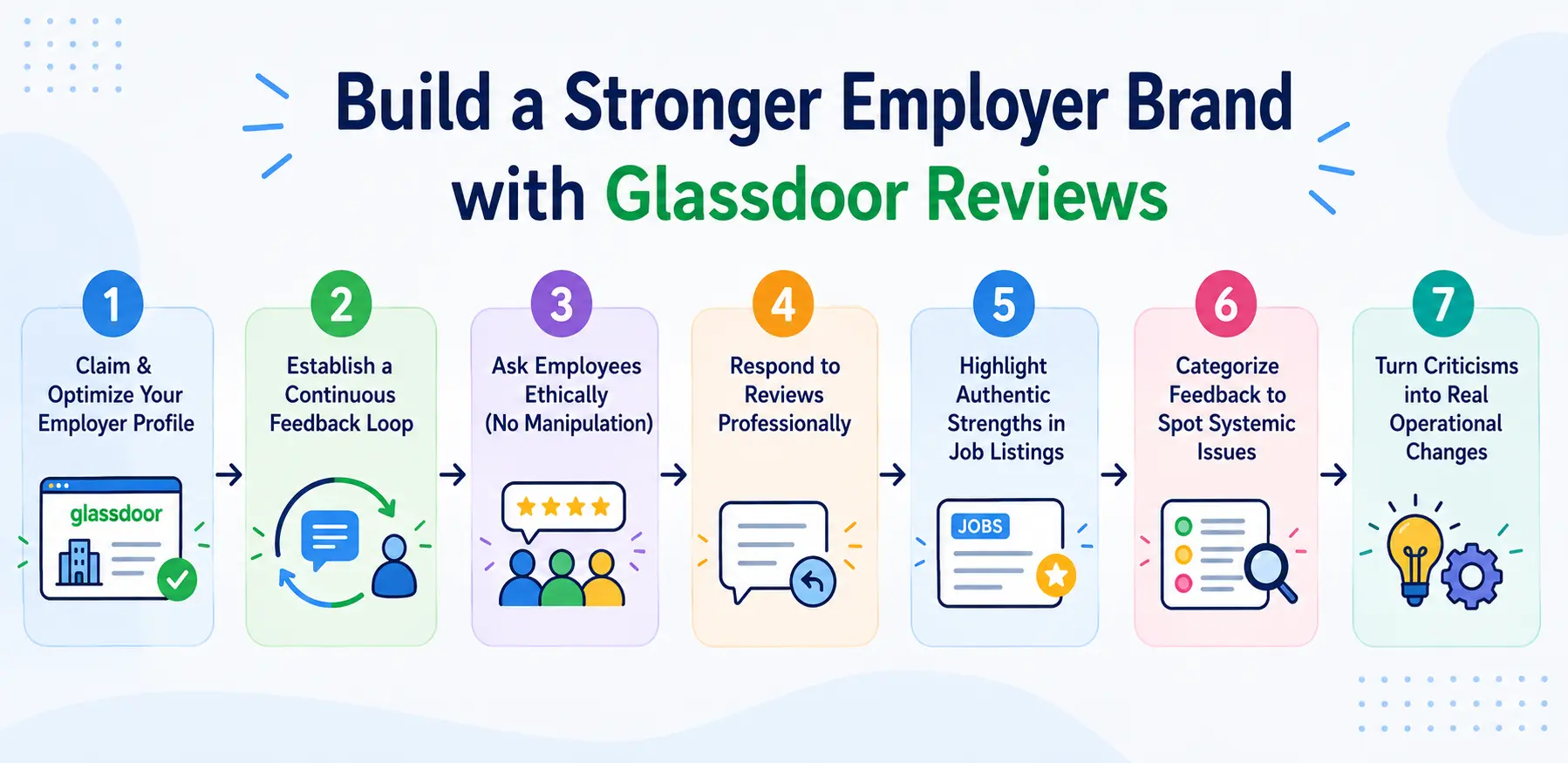
1. Claim and Optimize Your Glassdoor Employer Profile
Start by taking ownership of your profile. A free Glassdoor employer account allows you to update baseline company information, mission statements, benefits, and workplace photos.
2. Establish a Continuous Feedback Loop
Do not wait for angry employees to voice their concerns online. Conduct internal pulse surveys and quarterly check-ins to catch issues early.
3. Ask Employees for Reviews Ethically
Maintain a steady influx of honest reviews by asking staff to leave feedback broadly across departments, rather than selectively sampling happy teams.
4. Respond Professionally to Reviews
Acknowledge both positive and negative employee reviews. Replying shows current staff and candidates that executive leadership values transparency.
5. Highlight Genuine Strengths
Use positive themes from employee feedback in recruitment efforts. If reviews praise your training programs or remote policies, feature those benefits on your career site.
6. Categorize Feedback to Spot Systemic Issues
Track recurring keywords in negative feedback. If multiple reviews mention outdated tools or poor middle-management communication, treat those entries as operational data points.
7. Turn Employee Feedback into Real Workplace Improvements
The ultimate way to improve your Glassdoor rating is to improve the workplace itself. Address compensation gaps or burnout issues and share updates internally so staff see their input matters.
How to Respond to Negative Glassdoor Reviews
Companies should acknowledge the reviewer's perspective calmly, thank them for the feedback, address the specific operational issue without revealing confidential information, and avoid defensive language or attempts to identify the employee.
When responding to critical comments, keep these core guidelines in mind:
Never act defensively: Arguing with a former employee in a public forum always harms the employer's image.
Maintain confidentiality: Never share personnel details or severance terms in your reply.
Keep responses focused on solutions: Acknowledge the experience and outline recent initiatives toward workplace improvement.
Example Response:
"Thank you for sharing your feedback. We are sorry to hear that your experience with our management structure fell short of expectations. We take concerns regarding internal communication seriously, and over the past quarter, we have rolled out new leadership training modules to better support our team leads. We appreciate your contributions to the company and wish you the best in your next step."
How to Get More Genuine Glassdoor Reviews
Building a steady stream of authentic employee feedback requires embedding review requests naturally into the employee lifecycle:
Onboarding Check-ins: Ask new hires to review the recruitment process after 60 or 90 days.
Work Anniversaries: Send automated anniversary emails thanking employees and inviting honest feedback.
Exit Interviews: Provide departing employees with a link to your profile, emphasizing that candid feedback helps the organization grow.
How to Measure Glassdoor Reputation
To evaluate whether your employer branding efforts are working, monitor key metrics over quarterly periods:
Metric | What It Measures | Ideal Trend |
Overall Star Rating | Aggregate employee sentiment | Stable or upward trend (3.8 - 4.5) |
CEO Approval Rating | Leadership confidence | Consistently above 70% |
Recommend to a Friend % | Employee advocacy | Consistently above 70-75% |
Review Volume & Frequency | Engagement level | Regular, organic monthly posts |
Glassdoor Reviews and Online Reputation Management
Your Glassdoor footprint plays a critical role in your broader online brand reputation. When prospective employees or enterprise clients search for your company name on Google, your Glassdoor employer profile frequently appears on the first page of search results. Star ratings displayed directly on search engine results pages shape first impressions instantly.
Integrating your Glassdoor strategy with your broader online reputation management ensures that public messaging aligns with internal culture.
Sustainable Reputation Management Starts Within
Improving your brand reputation with Glassdoor reviews is not about controlling the narrative, it is about responding to reality. Shortcuts like buying fake reviews or pressuring staff for ratings will erode trust and trigger platform penalties.
Focus on the fundamentals: optimize your company profile, encourage continuous feedback, handle negative comments with composure, and address valid workplace concerns. Over time, an authentic Glassdoor presence becomes one of your strongest recruitment assets.
Explore our tailored review management solutions to help monitor, analyze, and elevate your online reputation ethically.
Frequently Asked Questions
Why are Glassdoor reviews important for brand reputation?
Glassdoor reviews show what employees think about your company. Positive reviews help build trust and attract better talent.
How do Glassdoor reviews impact hiring?
Job seekers check reviews before applying. Good ratings and feedback make your company more attractive to skilled candidates.
Can Glassdoor reviews affect overall business reputation?
Yes, employee reviews influence how people see your brand. A positive workplace image can improve customer trust as well.
How does Get Reviews Buzz help improve Glassdoor reviews?
Get Reviews Buzz helps businesses get more quality reviews, improving their employer brand and online reputation.
Can Get Reviews Buzz help build trust with job seekers?
Yes, more positive reviews make your company look reliable and a better place to work, which attracts more applicants.
How can businesses use Get Reviews Buzz to strengthen their employer brand?
Businesses can use it to improve ratings, collect feedback, and present a strong company image to both employees and customers.